Article
No logo.
This article follows on from article "Contrefaçon: rançon de la gloire ou véritable menace?" from June 2025, which can be read here.
No logo, no problem.
Wearing counterfeit goods proudly and without scruples has become a trend, especially among young people; a brand conveyed by a logo on a counterfeit item is sufficient in itself: people benefit from the brand's visual codes without paying the price. In a 2022 study of people aged 15-24 across the EU, findings show 37 percent of young people bought one or several fake products (mostly clothing) intentionally in the last 12 months.
The loss of revenue is obvious for brands, not only in terms of income but also in terms of the credibility of their image.
In order to counteract this trend, some ready-to-wear brands have therefore decided to adopt a strategy that defies all traditional logic of visual identity: the outright removal of any visual representation of their logo on their products. This is mostly done on textile products.
This is not the phenomenon called "dupe" (derived from "duplicate"), the creation of a product that imitates the visual codes of an existing brand, but rather a branded product that has deliberately abandoned its main element of authentication: its logo.
No logo, no more problems.
Abercrombie & Fitch (A&F), whose story will be covered in a future article, had been basing its success on the massive presence of its logo on its clothing line. In the early 2000s, a medium-quality t-shirt bearing the A&F logo could sell for much more. The logo was the vehicle for the values of the American brand. Counterfeiters understood this too: copies flooded the parallel market, and it was difficult to distinguish a fake from a real one.
Under the leadership of the new CEO in 2017, A&F, after a decisive repositioning, decided to simply abandon the presence of the logo as a graphic element (A&F sometimes replaced it with a moose...), in order to no longer focus its notoriety exclusively on this "product advantage" and to direct consumer attention to another inimitable criterion: quality. A slap in the face for counterfeiters. Conversely, some brands have not followed this strategy for a portion of their production, for which the logo remains the primary signature. Chanel and its style of haute couture are instantly recognizable due to their timeless, understated, and elegant character. There's no need for a logo on the chest to identify it; in fact, one could even say that not displaying it is the epitome of elegance. However, for mass-produced items intended for a wider audience, Chanel does not hesitate to display its famous interlocking double C logo.
Without logo but with a strategy.
By adopting both strategies for different product segments, these brands benefit from the following two advantages:
- The "aspirational" effect: the brand generates desire with a well-established reputation thanks to a subtle identity (identification) (= without logo);
- The "capture" strategy: the brand can reach a previously inaccessible audience through more immediate and obvious visibility (= with logo).
In any case, the benefit-risk balance lies between being copied and being diluted in the mass market. Bis repetita placent.
Resources :
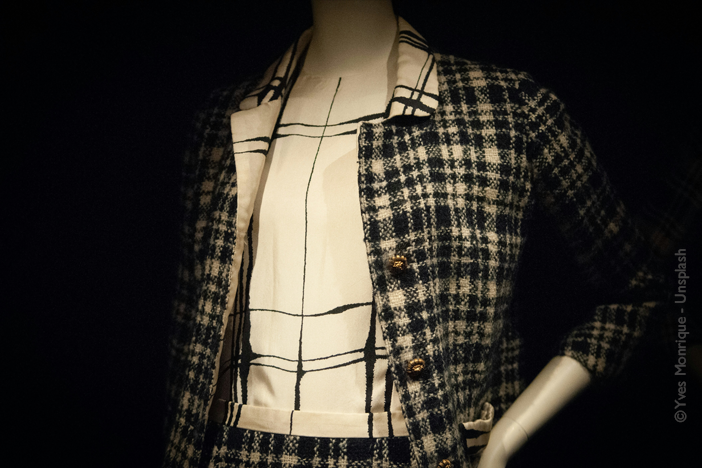 Chanel timeless outfit
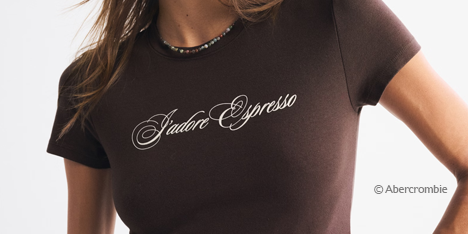 Abercrombie t-shirt without logo in 2025
Author
Etienne Lens
Tags
marketing strategy Abercrombie Chanel counterfeit capture strategy dupe aspirational effect
Share